
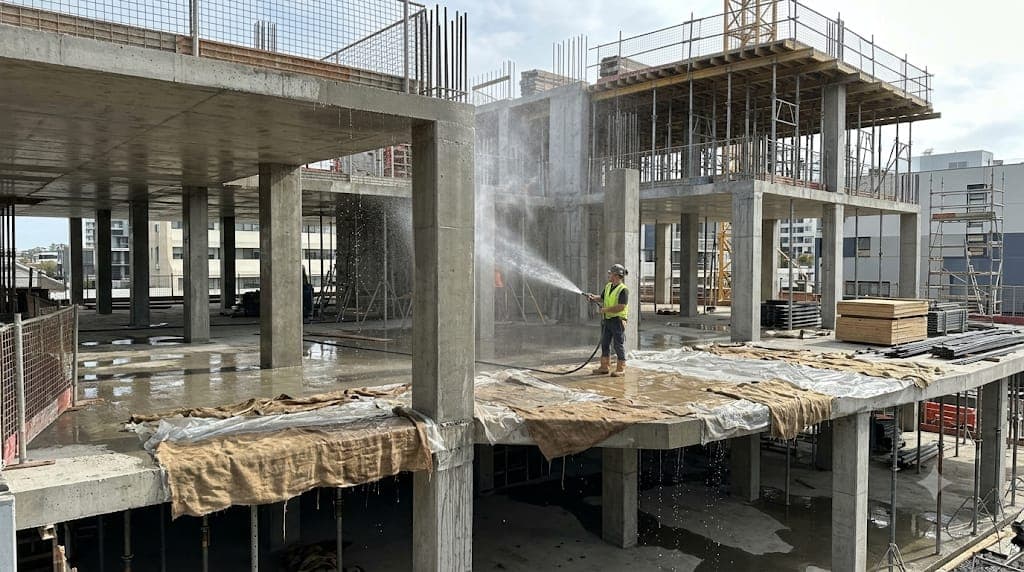
Proper concrete curing is essential for building strength, durability and long-term performance. It helps prevent cracks, protects reinforcement steel, and reduces water seepage. Discover why correct curing methods, sufficient moisture and recommended curing periods play a vital role in construction quality. Learn how Manovsis Reality prioritises proper curing to build safer, stronger and more durable structures.
In structural reinforced cement concrete (RCC) works, the true quality of concrete is decided not only at the batching plant, but during the hours and weeks that follow placement. Concrete does not simply 'dry' to harden; it cures through an ongoing chemical reaction known as hydration. Curing maintains adequate moisture and favourable temperature conditions within freshly placed concrete, enabling the cement matrix to realize its full structural strength, durability, and impermeably.
Why Concrete Curing is Essential
1. Facilitates Hydration & Compressive Strength Gain
Concrete hardens through the chemical reaction between water and cementitious compounds (hydration). When surface moisture evaporates too quickly, hydration ceases prematurely. Proper curing ensures that the capillary pore network is continuously filled with water, allowing crystals of calcium silicate hydrate (C-S-H) gel to form and achieve full design compressive strength.
2. Controls Plastic & Drying Shrinkage Cracking
Rapid moisture loss from freshly placed concrete causes plastic shrinkage and surface micro-cracking, particularly on exposed slabs subject to ambient heat and wind. As the concrete hardens, drying shrinkage can widen these cracks. Consistent curing keeps the surface moist, minimizing differential shrinkage and surface crazing.
3. Improves the Durability of Concrete
A building is expected to remain safe and serviceable over decades. Effective curing produces a dense, compact microstructure with reduced permeability. This tightly packed barrier prevents ingress of corrosive agents such as chlorides, airborne sulphates, and atmospheric carbon dioxide, protecting against concrete deterioration.
4. Protects Reinforcement Steel from Corrosion
Reinforcing steel relies on the alkaline passivating film provided by healthy concrete. Porous, poorly cured concrete facilitates carbonation and moisture migration directly to the rebar cage. This initiates active corrosion, resulting in rust expansion, spalling, and severe structural section loss. Thorough curing safeguards this crucial protective cover.
5. Reduces Water Seepage and Leakage
Permeability in water-retaining structures, roof slabs, balconies, and wet areas frequently traces back to improper early curing. While curing alone cannot substitute for engineered waterproofing and construction joints, it eliminates continuous capillary pathways, dramatically boosting resistance against water penetration.
6. Common Methods of Curing in Buildings
Different curing methods are adopted depending on structural geometry, exposure, and site water availability:
Curing Method
Application & Description
Ponding
Water is retained across horizontal surfaces (roof slabs, grade slabs) using clay or mortar bunds. Ideal for large flat areas.
Wet Covering
Surfaces are wrapped in saturated burlap, hessian cloth, or gunny bags. Ideal for vertical columns, beams, and sheer walls.
Sprinkling / Spraying
Continuous or periodic mist/fog spraying maintains damp surfaces without washing away fresh paste.
Immersion
Precast members, pavers, and test cubes are fully submerged in curing tanks for controlled hydration.
Membrane Curing
Liquid-applied wax or resin-based curing compounds are sprayed to form an impermeable evaporation barrier where water is scarce.
Recommended Curing Periods (IS 456:2000 Standards)
As stipulated under IS 456:2000, Clause 13.5, mandatory minimum curing durations are:
Ordinary Portland Cement (OPC): Minimum 7 days under standard environmental conditions.
Blended Cements & Mineral Admixtures: Minimum 10 days for PPC, PSC, or mixes with fly ash/slag due to slower hydration kinetics.
Hot, Dry, or Windy Weather: Curing must be extended to at least 10 days for OPC and 14 days for blended mixes to counteract high evaporation.
Common Curing Pitfalls to Avoid on Construction Sites
Starting Curing Too Late: Waiting until concrete has fully hardened permits catastrophic early-stage evaporation and micro-cracking.
Intermittent / Irregular Watering: Alternating between soaking and complete drying induces cyclical thermal and moisture stress, creating surface spalling.
Premature Termination: Halting curing after 3–4 days because the surface looks dry-hard forfeits up to 30% of potential compressive strength.
Neglecting Vertical Elements: Columns and retaining walls require wrapped gunny bags; simply splashing water once daily is insufficient.
Overlooking Hot & Windy Climates: High temperatures accelerate surface drying exponentially, demanding shade screens and continuous wet coverings.
Unplanned Formwork Stripping: Stripping forms without immediate curing measures leaves vulnerable green concrete exposed to immediate desiccation.
Site Engineer's Practical Curing Checklist
Curing commences immediately upon initial set without disturbing finished surfaces.
Uninterrupted potable water supply and dedicated curing labour are secured on site.
Roof and floor slabs are actively ponded with bunds maintained free of breaks.
Vertical columns and shear walls are fully wrapped with saturated hessian/gunny bags.
Concrete surfaces are inspected twice daily to ensure zero dry patches during the cycle.
Curing periods strictly satisfy IS 456 specifications (7–14 days based on mix/climate).
Daily curing logs and site verification registers are signed by the quality engineer.
Conclusion & Quality Commitment
Curing is among the simplest yet most decisive interventions in structural engineering. A premium concrete mix design and meticulous reinforcement detailing remain incomplete without dedicated curing. At Manovsis Reality India Pvt Ltd. we treat curing not as an afterthought, but as an indispensable investment in building resilience, safety, and client trust.
“Good concrete is not just about what you pour; it is about how well you cure it.”